

What SMB Multichannel Does
SMB stands for Server Message Block, a protocol that can effectively increase data transfer throughput on an Ethernet network while still staying within its nominal speed limits.
Think of it like this: if you need to move 50 people along a single-lane road with a 100 km/h speed limit and only one bus can travel at a time, you can move a maximum of 50 people in an hour over a 100 km route. Add a second lane so two buses can travel simultaneously and you double the capacity without exceeding the speed limit. SMB Multichannel does the same for network traffic by using multiple network links in parallel.
How It Works in Practice
On a network, the speed limit is expressed in megabits per second. A gigabit network has a 1 Gbps ceiling per single connection. But with SMB Multichannel 3.0, which is enabled by default on Windows, macOS, and many Linux distributions, a single SMB session can use multiple physical NICs at once, aggregating bandwidth between systems such as a PC and a NAS.
The primary hardware requirement is straightforward: both the NAS and the PC must have two or more network ports.
Real-World Results
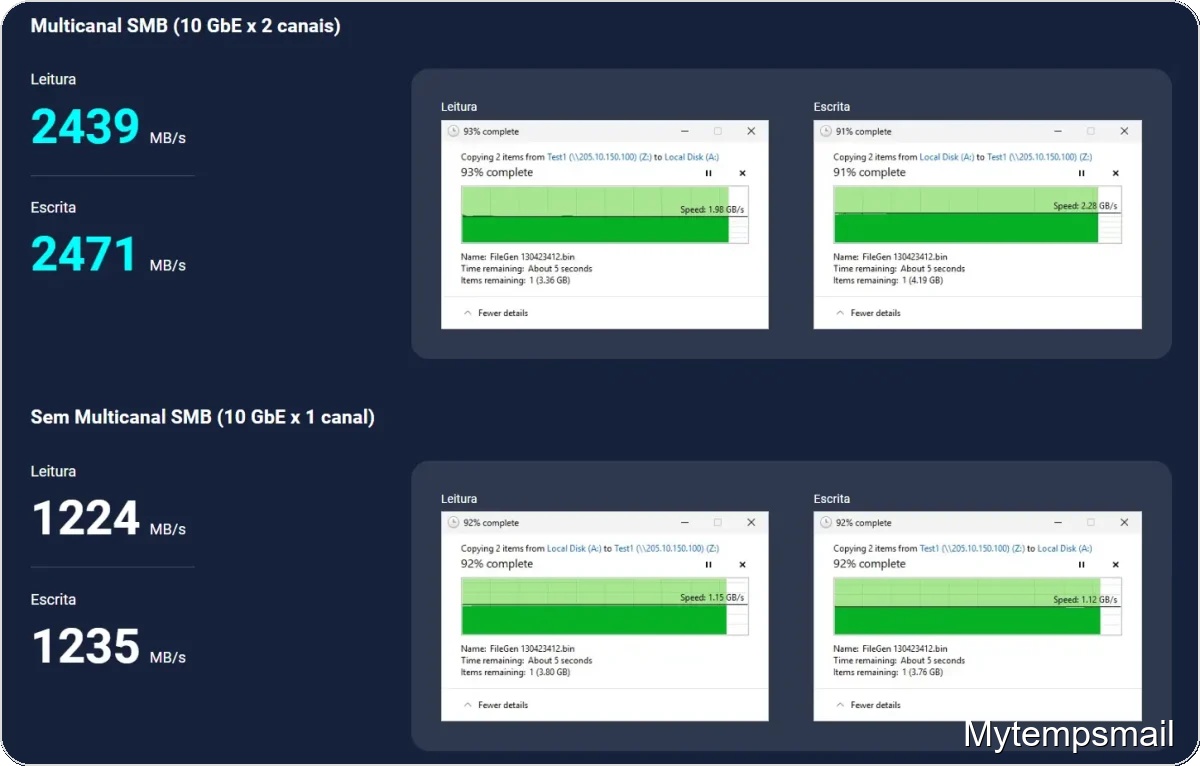
QNAP recently published a video on its YouTube channel in Portugal showing this in action. On a gigabit network, they observed throughput rise from about 880 Mbps to roughly 1,500 Mbps after adding a second network card to the PC — an increase of nearly 75%.
Not Limited to Gigabit Networks
SMB Multichannel works on any Ethernet network. That means the same approach can increase aggregate throughput on 2.5 Gbps and 10 Gbps networks as well, not just gigabit links.
